By Rupesh Garg, Frugal Testing, Founder

Effective data governance is a keystone in the life sciences industry, which plays a vital role in ensuring the maintenance of data integrity, patient privacy and also complying to the stringent regulatory standards. This leads to the establishment of a structured framework for data management, which is pivotal in making it easier to make informed decisions, nurture innovation and diminish any potential pitfalls. Being a part of a generation which is marked by increasingly complex as well as regulatory scrutiny, the life sciences industry is at the forefront, making its urgency to adapt and harness the capabilities of big data as well as advanced analytics all the more obvious.
Such tools are not only meant for compliance but also act as the powerful enablers, who manage risks effectively. Furthermore, looking at the bigger picture, we can state that data governance transcends mere compliance. In fact it offers considerable business benefits, such as enhanced data analytics and improved operational efficiency. Streamlining data management processes, can lead organizations to minimize the need for repetitive data formatting and correction, which in turn would be helpful for having ease of access in terms of data, which further would be used readily in various applications.
This aspect is important in an industry where the process of data revolution is ongoing, characterized by the generation of huge volumes of information taken from diverse sources including clinical trials. Additionally, when focussed more on regulatory compliance, effective data governance pops up to play an important role in protecting privacy and innovation, which would lead to accelerating advancements in research. Therefore, the chief element in the life sciences sector could be said where the integrity and confidentiality of data are principal. The point of assuring data compliance and security becomes the backbone of a firm healthcare ecosystem in process. But when we dig deeper, there is no better way to ensure proper governance and compliance in LifeSciences other than testing. 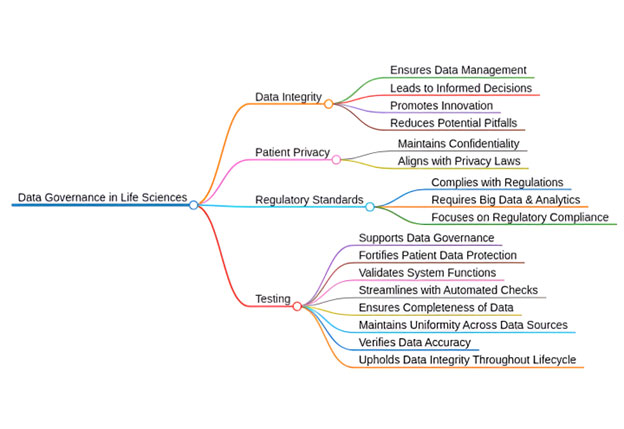 Role of Testing in Data Governance and Compliance in Life Sciences
In fact testing in Data Governance and Compliance within the Life Sciences industry encompasses a range of methods, each targeting specific aspects to ensure the integrity, security, and functionality of data and systems: Fortifying patient data protection: Security-centric testing plays a pivotal part in protecting the sensitive patient information. By identification and rectification of vulnerabilities, these testing get aligned with privacy laws like HIPAA, building confidence in data protection and supporting the objectives of data governance.
Validating systems functions for reliable data management:
Functional testing helps in assessment of the accuracy in regards to the patient data management systems as well as clinical trial databases. Making sure that these systems align well with their functions, functional testing helps uphold the data quality and reliability which is essential for effective data governance.
Streamlining processes with automated checks:
Automated testing displays its benefits in managing extensive data which is a norm in life sciences. This further leads to enhancement of the efficiency as well as accuracy of the testing process. While adding in to this is the assurance of ongoing compliance and integrity of data and key elements in firm data governance frameworks.
Ensuring completeness of vital data sets:
Tests that help in verification of the completeness of the data are vital in life sciences, as it is a segment where even the smallest segment of data can impact outcomes. Testing ensures that all the required information is present, which is followed up by the effectiveness of data governance practices.
Maintaining uniformity across diverse data sources:
Within the life sciences, the data generally is from various sources, wherein testing ensures uniformity and adherence to standards. This is very much pivotal for well founded data integration and reporting, supporting the principles of data governance.
Verifying data accuracy for trustworthy analysis:
Testing is also important to ensure that the data is able to align with real-world scenarios. In life sciences, where accuracy of data is able to impact the research validity and patient safety, testing is able to get along with the objectives of data governance.
Upholding data integrity throughout its lifecycle:
Data Integrity testing ensures that the data remains consistent and constant throughout its lifecycle. In life science, data integrity lies as a key to maintain trust in various data-driven processes and decisions which is a fundamental aspect of data governance.








Latest News